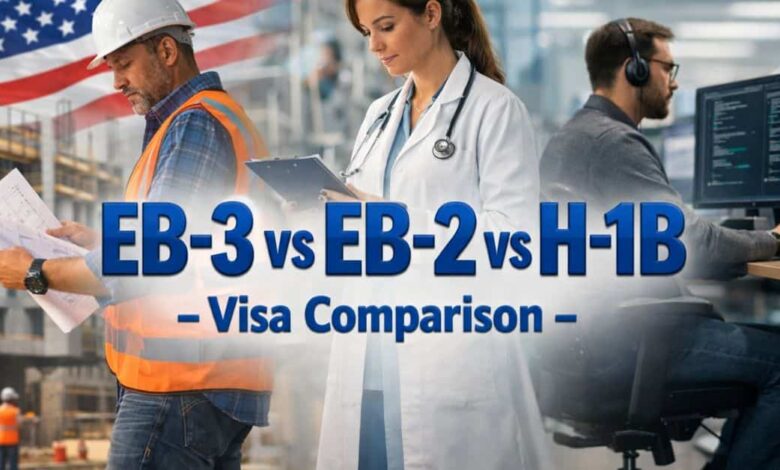
Choosing the right U.S. work visa can shape your career, income, and long-term future. In 2026, competition is tighter, processing trends are shifting, and immigration scrutiny is higher than ever. If you’re weighing the EB-3, EB-2, and H-1B visas, this guide breaks down what truly matters eligibility, timelines, risks, and long-term strategy.
Overview:
At a glance:
- H-1B → Temporary work visa (non-immigrant)
- EB-2 → Employment-based green card (immigrant)
- EB-3 → Employment-based green card (immigrant)
The biggest difference?
H-1B is temporary. EB-2 and EB-3 lead to permanent residency (Green Card).
Check Also: EB-3 Visa Predictions & Priority Date Forecasts
What Is the H-1B Visa?
The H-1B visa allows U.S. employers to hire foreign professionals in specialty occupations requiring at least a bachelor’s degree.
Key Points (2026):
- Subject to annual lottery cap
- Valid for up to 6 years (initial 3 + extension)
- Requires employer sponsorship
- Dual intent (you can pursue a green card later)
Who It’s Best For:
- Tech professionals
- Engineers
- Accountants
- Healthcare professionals
- Recent U.S. graduates
Main Risk:
Lottery selection is not guaranteed. Even qualified applicants may not be selected.
What Is the EB-2 Visa?
The EB-2 visa is a green card category for professionals with advanced degrees or exceptional ability.
Eligibility Requirements:
- Master’s degree or higher (or bachelor’s + 5 years experience)
- Job offer (unless applying through National Interest Waiver)
- Labor certification (PERM) in most cases
Advantages in 2026:
- Faster priority dates than EB-3 for many countries
- Direct path to permanent residency
- No lottery system
Who It’s Ideal For:
- Professionals with strong academic credentials
- Individuals with specialized skills
- Entrepreneurs (via NIW)
What Is the EB-3 Visa?
The EB-3 visa is another employment-based green card category, but for:
- Skilled workers (2+ years experience)
- Professionals (bachelor’s degree)
- Other workers (less than 2 years training)
Pros:
- Broader eligibility than EB-2
- Accessible for mid-level professionals
Cons in 2026:
- Longer wait times for certain countries
- PERM labor certification required
- Slower movement compared to EB-2 (in many cases)
Processing Time Comparison 2026:
While timelines vary by country of chargeability, general trends in 2026 look like this:
- H-1B: 3–8 months (lottery dependent)
- EB-2: 1.5–3+ years (depending on backlog)
- EB-3: 2–4+ years (can be longer for high-demand countries)
Important: Country of birth significantly affects wait times.
Salary and Employer Requirements:
H-1B:
- Must meet prevailing wage
- Employer controls sponsorship
- Changing jobs requires transfer filing
EB-2 & EB-3:
- Permanent, full-time job offer required
- Employer must prove no qualified U.S. workers available (PERM process)
- More documentation-heavy upfront
Flexibility and Career Mobility:
H-1B
- Easier job mobility (via transfer)
- Temporary status pressure
EB-2 / EB-3
- Long-term stability
- Once green card approved → full employment freedom
- No dependency on visa renewals
Risk Factor Comparison:
| Factor | H-1B | EB-2 | EB-3 |
|---|---|---|---|
| Lottery Risk | High | None | None |
| Denial Risk | Moderate | Moderate | Moderate |
| Backlog Risk | Low (temporary visa) | Medium | High (country dependent) |
| Long-Term Security | Low | High | High |
Which Visa Is Better in 2026?
The answer depends on your profile:
Choose H-1B if:
- You need to enter the U.S. quickly
- You have an employer ready to sponsor
- You plan to transition to a green card later
Choose EB-2 if:
- You qualify academically
- You want faster green card processing
- You’re eligible for National Interest Waiver
Choose EB-3 if:
- You don’t meet EB-2 criteria
- You have steady employer sponsorship
- You’re willing to wait longer for residency
Strategic Pathways:
Many professionals use this strategy:
- Enter the U.S. on H-1B
- Employer files EB-2 or EB-3
- Adjust status to permanent resident
This hybrid route balances speed and long-term security.
Final Verdict:
- If your goal is permanent residency, EB-2 is often the strongest option when eligible.
- If your goal is a quick U.S. entry, H-1B remains the most practical starting point.
- If you qualify under broader categories and are patient, EB-3 is a solid alternative.
In 2026, immigration success isn’t just about eligibility it’s about timing, strategy, and documentation strength. Choosing the right visa early can save years of delay and thousands in legal costs.
Conclusion:
In 2026, H-1B offers quick U.S. entry but is temporary, while EB-2 provides faster green card processing for advanced professionals. EB-3 is broader but often slower, ideal for skilled workers and mid-level professionals. Choosing the right visa depends on your qualifications, career goals, and long-term residency plans.
Frequently Asked Questions:
What is the main difference between H-1B and EB visas?
H-1B is a temporary work visa requiring employer sponsorship and lottery selection, while EB-2 and EB-3 are employment-based green cards that lead to permanent residency.
Who qualifies for EB-2 versus EB-3?
EB-2 requires an advanced degree or exceptional ability, whereas EB-3 is for skilled workers, professionals with a bachelor’s degree, or other workers with less experience.
How long does it take to get each visa in 2026?
H-1B typically takes 3–8 months (lottery dependent), EB-2 around 1.5–3+ years, and EB-3 can take 2–4+ years or longer for some countries.